
Wagering requirements explained: this guide shows what rollover means, how it works, and why a bonus may be much harder to unlock than it first looks.
On the surface, a bonus can look generous. You see a deposit match, extra balance, or a big welcome offer and it feels like easy value. The problem starts when you look at the rollover. That is the part that decides whether a bonus is actually playable or whether it only looks good in a banner.
This guide explains wagering requirements in plain English, so players can understand what matters before claiming a bonus.
Wagering Requirements Explained for Casino Players
Wagering requirements are the amount you need to bet before bonus funds, or winnings linked to those funds, can become withdrawable.
You may also see this described as:
- rollover
- playthrough requirement
- bonus turnover
In practice, they all refer to the same basic idea: you must keep betting a certain amount before the casino treats the bonus balance as real cash you can take out.
How do wagering requirements work?
The easiest way to understand rollover is with a simple example.
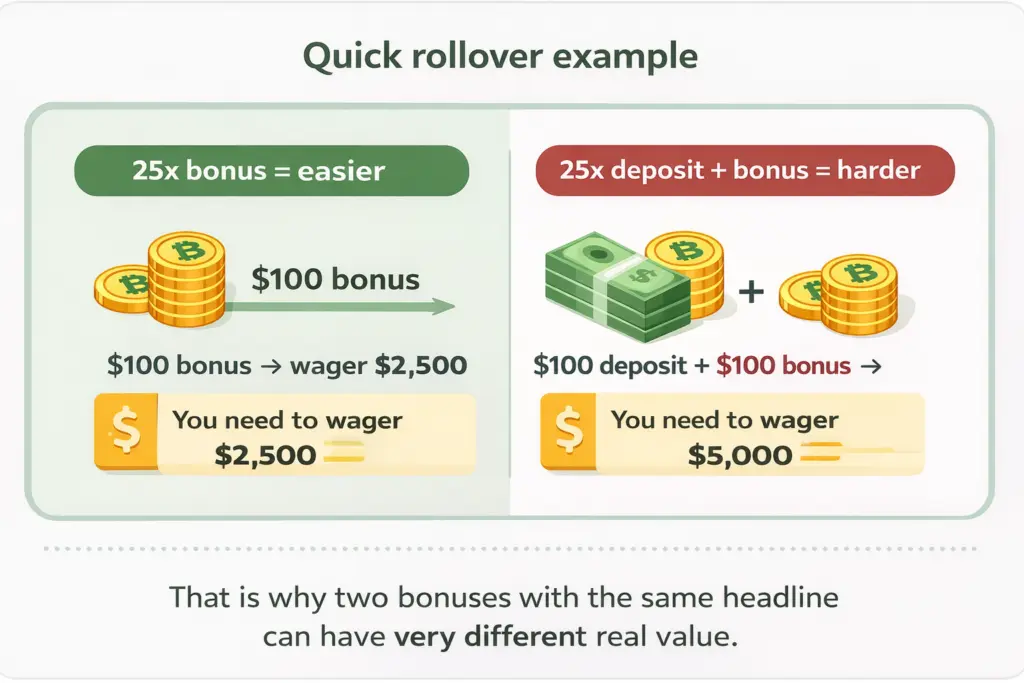
If a casino gives you a $100 bonus and the wagering requirement is 25x bonus, you need to wager:
$100 × 25 = $2,500
before the bonus can be fully cleared.
Some casinos calculate rollover on the bonus amount only. Others calculate it on the deposit plus bonus. That difference matters a lot.
Example 1: bonus only
Deposit: $100
Bonus: $100
Wagering: 25x bonus
You need to wager: $100 × 25 = $2,500
Example 2: deposit + bonus
Deposit: $100
Bonus: $100
Wagering: 25x deposit + bonus
You need to wager: $200 × 25 = $5,000
That is why two bonuses with the same headline can have very different real value.
Why wagering requirements matter so much
This is where many players get caught.
A bonus can look big, but if the rollover is too high, the value becomes much weaker in real play. That is why smart players do not start with the bonus amount. They start with the question:
Can this actually be unlocked?
That is the real point of rollover analysis. A bonus is not good just because it is large. It is good only if the terms still make sense once you look at:
- rollover
- game contribution
- time limits
- max cashout
- withdrawal restrictions
Bonus amount vs real bonus value
A bigger bonus is not always a better bonus.
Here is the real logic:
- a smaller bonus with lighter rollover can be more useful
- a large bonus with harsh rollover can be much harder to clear
- a bonus that looks great in the headline may be almost useless if the contribution rules are weak
That is why some offers feel designed for real use, while others feel designed mainly to attract clicks.
This wagering requirements explained guide is written for players who want to judge bonuses more realistically before claiming them.
What game contribution means
Game contribution tells you how much a game counts toward the wagering requirement. This is one of the most important details in any bonus.
For example:
- slots may count 100%
- table games may count 20%
- blackjack may count 10%
- roulette may count 5%
- some live dealer games may count 0%
That means not every dollar you bet has the same value when clearing rollover.
Example
If a player needs to clear $2,500 in wagering:
- with slots at 100%, every $1 bet counts as $1
- with table games at 20%, every $1 bet only counts as $0.20
So a player using low-contribution games may need much more actual play than expected.
Why slot players often clear bonuses more easily
This is why bonus pages often make more sense for slot players than for table-game players.
Slots usually contribute the most toward wagering. That makes the path to clearing a bonus more realistic, even if the game is still volatile.
Table-game players often run into the opposite problem:
- lower contribution
- slower progress
- more frustration
- bonus feels worse than expected
So when someone asks whether a bonus is “good,” the answer often depends on what they actually play.
Max cashout matters too
Many players focus on rollover first, but max cashout can be just as important.
A max cashout rule limits how much you are allowed to withdraw from a bonus or from winnings connected to that bonus.
Example: you claim a bonus, you win $800, terms say max cashout is $200. That means the real value of the offer is much lower than the balance might suggest.
This is why serious players often think in this order:
- max cashout
- rollover
- bonus amount
That order makes much more sense than looking only at the headline number.
Time limits and expiry rules
A bonus is not only about how much you need to wager. It is also about how long you have to do it.
Some offers expire quickly. Others give players more time. If a casino gives a high rollover but only a short time limit, the offer can become much harder to use in practice.
That is why a fair bonus should always be judged on:
- amount
- rollover
- contribution
- max cashout
- expiry window
Are wagering requirements always bad?
Not necessarily.
Wagering requirements are normal in the casino industry. A casino bonus is not free cash, so some form of rollover is expected.
The problem is not that wagering exists. The problem is when:
- the rollover is too high
- the contribution rates are weak
- the max cashout is too low
- the rules are hidden or unclear
A playable bonus usually feels transparent. A weak bonus feels like the real cost is buried in the terms.
How to check if a bonus is actually worth claiming
Before claiming a casino bonus, ask these questions:
- Is rollover based on the bonus only or deposit plus bonus?
- Which games count 100%?
- Are any important games excluded?
- Is there a max cashout?
- How long do I have to clear it?
- Do the terms match the way I actually play?
If the answer to those questions looks reasonable, the bonus may be worth testing. If not, the offer may look much better in the banner than in real use.
Overall, wagering requirements explained in simple terms can help players avoid bonuses that look strong in the banner but weak in real use.
Quick rule of thumb for players
A bonus is usually more realistic when:
- the rollover is moderate
- slots count fully
- max cashout is not too restrictive
- the rules are easy to understand
- the offer matches your actual play style
A bonus is usually worse than it looks when:
- rollover is very high
- many games contribute little or nothing
- max cashout is tight
- the wording is vague
- the casino makes the headline much easier to see than the real terms
Final take
Wagering requirements are the part of a bonus that turns “looks good” into either “worth trying” or “not worth the trouble.”
That is why players should never judge a bonus by the size alone. The real value comes from whether the offer can actually be cleared in a way that matches how you play. Once you understand rollover, contribution, max cashout, and expiry, most bonuses become much easier to judge.